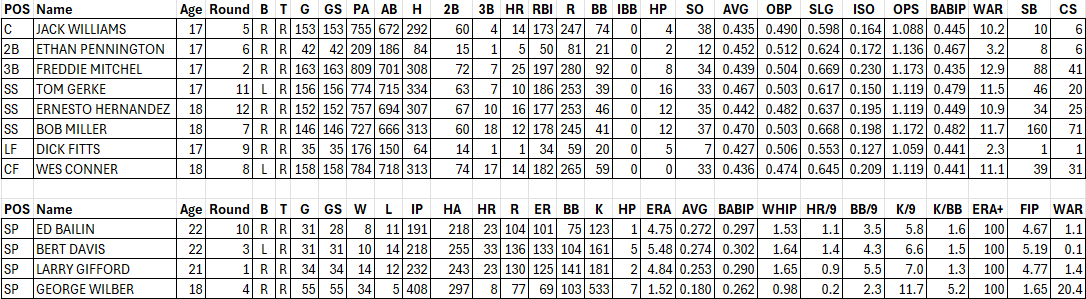
 ROUND 1
There was a huge fog of war hanging over the 1962 Ammy Draft. With us just getting control of our teams in January there wasn't a lot of time to scout
the players so I focused on the college players thinking they would be more advanced and quicker to scout. As it turned out the draft was kind of all
over the place once it started. The LA Suns stunned everyone by taking prep pitcher Joe Conner with the first overall pick. OSA had Conner
predicted to go in the middle of round four so I started to doubt not just my scout Charlie Green but also the OSA rankings. I was also starting to think
that one of the elite guys might drop to us at pick 13. If you read our last update then you know that we need quality position players in our minor
leagues. We have eleven prospects in the top 350 and according to OSA only one of them is a position player and we just acquired him in the past
month through a trade. The problem, as I saw it, is that there were no great college hitters left when our turn hit so we went with the best available.
The best available certainly is subjective but in Charlie Green's eyes there was no doubt. He threatened to retire if we didn't take 21-year-old Larry
Gifford out of Bluegrass State.
If Gifford had entered the draft a year earlier it's likely he's be doing something other than playing baseball for a living but this year it clicked with him.
In 1961 he was just another bad college pitcher but in 1962 he was an ace. He dropped his ERA a full three runs and gave up only four homers the
entire season compared to 19 in fewer innings pitched a year ago. OSA called him an impact player but Green swore he'd be an anchor for years to come.
He has six pitches and three of them are already considered elite. He still needs to work on his control but that's true of just about every pitcher in this draft.
He's a high work ethic guy who tends to motivate his teammates despite his seemingly low IQ. OSA had him going in the middle of the second round
so we are taking a pretty good leap of faith but that's what we pay Green to do.
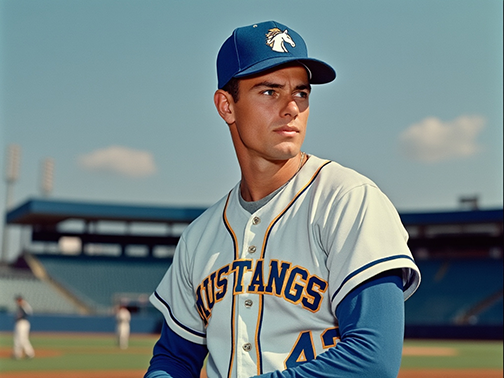 Larry Gifford(Bluegrass State Mustangs) 1962
10-4, 3.26 ERA, 18 GS, 124.1 IP, 109 HA, 45 ER,
4 HRA, 121 K, 2.8 WAR
ROUND 2
When the second round of the draft rolled around there was still some first-round talent, especially hitters, that we were hoping would continue
to drop to us. We had our eyes on catcher John Vance but he was taken with the fourth pick in the second round. Our attention then turned to
1B Dick Vitt but he was selected with the next pick. Herb Connelly was a guy we really liked and so did OSA. OSA had him as a first-round talent
but with a run of pitchers a few picks in front of us we were chomping at the bit to draft this kid who had just stolen 110 bases in 37 games. We
watched as the Kings drafted Connelly in the pick just before ours. We settled for high school third baseman Freddie Mitchel. The 17-year-old
Mitchel hit .435 and stole 73 bases himself while also scoring 73 runs. Green says at worst he'll be an average big leaguer. It's not the ringing
endorsement we were hoping for but the guys rated above him, like Bailey and Woods could hit better but neither could field worth a dime.
Mitchel has the potential to stay at third but may be better suited for a corner OF spot.
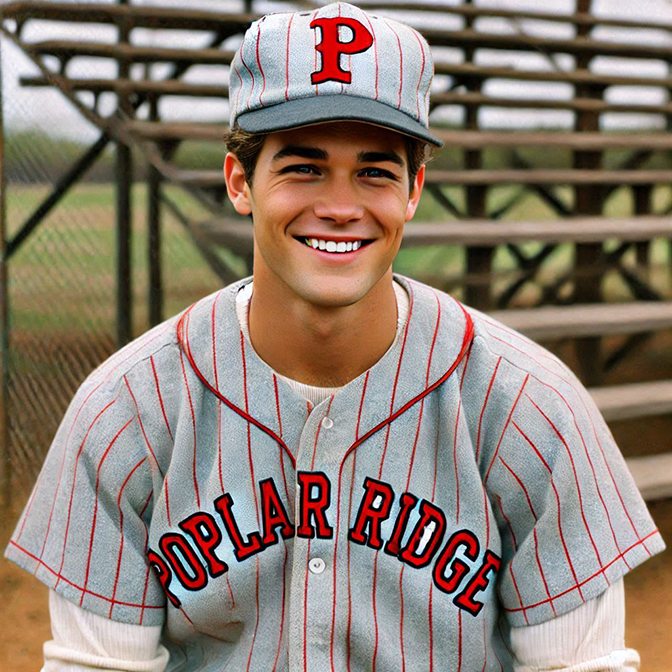 3B Freddie Mitchel(Poplar Ridge HS(NY) 1962 40 G, 73-201,
21 XBH, 73 RS, 49 RBI, 29 BB, 73 SB, 7 K
ROUNDS 3 ~ 12
Rounds three and four saw us take two more pitchers.
Bert Davis was another college guy who showed big
improvements from '61 to '62. The back of the rotation is his floor, and if he continues to improve, he can do much
better than that. He can eat up innings and save the bullpen when things are going well.
High schooler
George Wilbur was scooped up in the fourth. Wilbur tossed 106-plus innings his senior year
of high school and posted an ERA under 2.30. In his four years, it was his worst season and that may have been
what scared off some of the other teams. Of his seven pitches three are already considered elite and two more
are above average. He could end up towards the back of the rotation or he could end up as a stopper.
For the next eight picks, we selected just one pitcher and seven high school hitters. We tried to focus on
good work ethic and leaders among the top-rated by Green. We ended up with one catcher, four middle
infielders, two outfielders, and a partridge in a pear tree. If one or two of these guys ever crack the forty-man
roster then it will be considered a great draft. We still have eight more rounds to go for the established
teams and then 15 rounds after that for the four expansion squads.