|
All Star Reserve
Join Date: Dec 2001
Location: Indiana
Posts: 974
|
1963 Recap
Scoop Mitchell’s Windy City Wrap-Up – 1963 Chiefs Edition
Chicago, Illinois – The ride has come to a halt, folks, and what a ride it was. The Chicago Chiefs once again find themselves in sixth place, but this sixth-place finish feels a heck of a lot different than last year’s. Ten games over .500 sure beats four games under, and while it wasn’t a season for the ages, it was one that showed promise, grit, and just enough flashes of brilliance to keep the faithful hopeful for ’64.
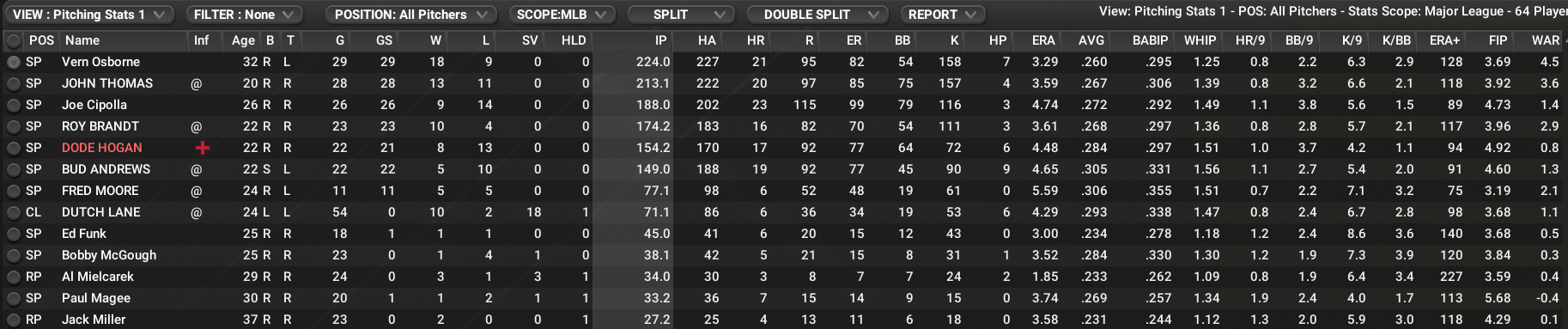
Let’s start with the arms because, for the first time in a while, the Chiefs could boast a pitching staff that wasn’t just trying to survive—it was making hitters sweat. The club’s team ERA dropped from 4.86 to 3.99, with the bullpen leading the entire FED in ERA. That’s right—best in the league. Rookie Rule V pickups Ed Funk, who posted a 3.00 ERA, and Bobby McGough, who had a 3.52 ERA, proved their worth alongside steady veterans like Al Mielcarek with a 1.85 ERA, Jack Miller at 3.58, and Paul MaGee at 3.74. The biggest headache? Young stopper Dutch Lane, who finished with a 4.29 ERA in 71.1 innings but couldn’t string together consistent outings. If Lane stumbles next spring, don’t be surprised if manager Dutch Becker and pitching coach Earl Scott hand the ninth-inning duties over to Mielcarek and let Lane get right in lower-leverage spots.
Up in the rotation, Vern Osbourne proved he’s still got ACE stuff, posting 18 wins and a rotation-best 3.29 ERA. The 32-year-old still has gas left in the tank, and with John Thomas stepping up as a reliable number two, recording a 13-10 record with a 3.59 ERA, the Chiefs have a solid top of the rotation. Rookie Roy Brandt showed he belongs as well, going 10-4 with a 3.61 ERA over 174.2 innings in a six-man setup that Chicago ran due to a packed schedule of doubleheaders. The plan next year is to shift back to five starters, but with the likes of Joe Cipolla, who went 9-14 with a 4.74 ERA, Dode Hogan at 8-13 and 4.48 ERA, and Bud Andrews with a 5-10 record and 4.65 ERA, battling for two spots, along with a crop of young guns coming up from AAA Fort Wayne, it could make for an intriguing spring competition.
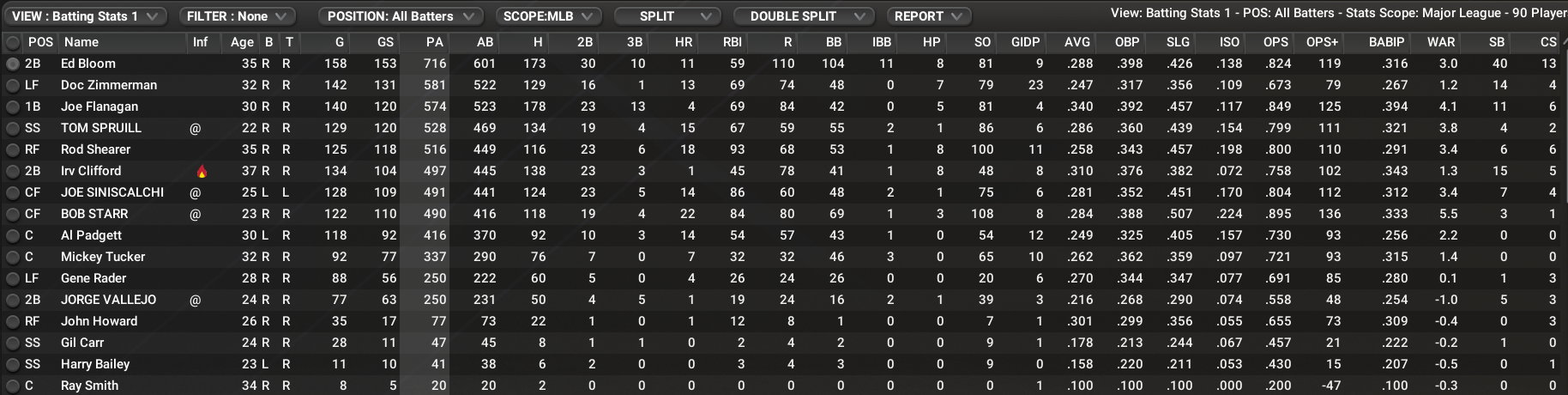
On the offensive end, the Chiefs’ team batting average dipped from .278 to .269, which ultimately held back the offense. But not everything was a letdown—especially in the field. The outfield defense was vastly improved when the trio of Siniscalchi, Starr, and Shearer took the field together. Starr’s emergence in center allowed Shearer to slide back to right, where he belongs, while Spruill’s steady play at shortstop stabilized the infield defense. And let’s not forget that Shearer finished strong, blasting seven homers in September after bouncing back from injury.
After a slow start, Ed Bloom finished the year with over 100 walks for the 13th consecutive season. That’s quite a stretch, as he finds himself sitting in fourth place all-time, just 110 bases on balls shy of tying Mighty Max Morris for the career record. Bloom wasn’t all about the walks, as he fought all season to raise his batting average to .288 after finishing April at .236. He also led the Chiefs with 110 runs scored, marking his 13th straight season with 90 or more. At the ripe old age of 35, Bloom swiped a career-high 40 bases in 1963, just one off the FABL lead.
Sophomore Joe Flanagan led the team with a .340 batting average after starting the season on the bench. Flanagan proved he should be an everyday player by hitting well and holding his own at third base. "He didn't embarrass himself at third base like we thought he might," Becker said when asked about Flanagan's fielding abilities. Spruill wasn't all glove, either, as he hit a respectable .286 with 15 homers and 67 RBI.
Another rookie, Jorge Vallejo, struggled at the plate, hitting just .216 with 19 RBI, and his defensive play left plenty to be desired. Meanwhile, 37-year-old Irv Clifford can still swing a bat, hitting .310, but he played like a statue at second base and became a defensive liability.
The catching duo of Al Padgett and Mickey Tucker saw their numbers decline compared to 1962, and Tucker’s incessant whining about playing time hasn’t exactly won him any friends in the front office.
So what’s next? If injuries don’t interfere, Becker should be penciling in Siniscalchi, Starr, and Shearer 150 times next season—that trio proved they can get it done. The Chiefs took a step forward this year, and while they still have work to do to chase down St. Louis, the pieces are coming together. With the pitching staff showing real potential and the young guys growing into their roles, Chicago might just be on the verge of making noise.
The 1963 season wasn’t a fairy tale, but make no mistake—it was a chapter worth reading. Let’s see what happens in ’64.
-John "Scoop" Mitchell, Windy City News Sportswriter
__________________

|